


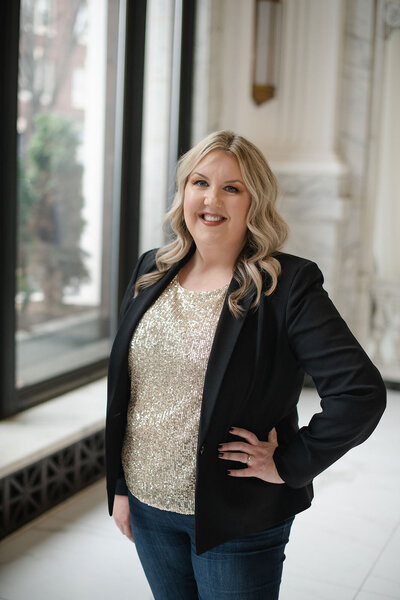
My client, Jennifer, spent four plus years as a clinical trial manager. Her leadership praised her, handed her work well above her level, and yet, her promotion didn’t come. She had become too useful exactly where she was.
Jen came into The Right Move Protocol with a one year goal. In just one month, she had a promotion she was not expecting. A short time later she identified her ideal role with her dream company. By using the skills she learned and applying her growth mindset she negotiated and accepted an Associate Director position in a therapeutic area she had been trying to get into for years. She did it while her family had more going on than she ever could have anticipated.
What You’ll Learn
- What “developed in place” really means, and why the praise is not progress
- Jen’s 90% rule for deciding before you feel ready
- Why the part of the program she dreaded is the part that got her results the quickest
- What she says to anyone who thinks her results were luck or timing
- The negotiation truth that follows you from job to job
Connect with Jennifer on LinkedIn here.
Key Takeaways
Being developed in place is not the same as being developed. Jen’s leadership was efficient with her. They gave her stretch work, praised her openly, and kept her exactly where she was. The false belief is that visible effort eventually converts to a title. In pharma and CRO structures it converts to dependence.
Jen’s 90% rule. She was 95% sure before she joined, and that was enough. Scientists rarely rate anything a ten, so waiting for certainty means waiting forever. If the good outweighs what makes you nervous and you are past 90, go.
The part she dreaded is the part that worked. Group coaching was her biggest hesitation, and it became her fastest lever. Sitting with VPs, immunologists, and portfolio level women, she saw the same ceiling showing up at every level. That is what told her the problem was structural, not personal.
Your excellence is real. Making your value visible is the strategy. Your 100% is often someone else’s 150%, and that is exactly what gets high performers stuck. Advocates, documentation, and knowing how your organization actually decides are what move you. Position yourself to be undeniable instead of waiting to be discovered.
Your salary at each job becomes the floor for the next one. Employers know this. Every offer you accept below market compounds into a deficit you carry for the rest of your career. Negotiate every time, even when the HR business partner sounds surprised.
The Bottom Line
Getting promoted in pharma and biotech is not a reward for output. It is a decision other people make in rooms you are not in, based on what they believe you are for. Jen’s shift was not working harder. It was making her value legible to the right people and then refusing to repeat the pattern in her next role, which is why she is walking into her associate director position with a 90 day plan instead of a fresh set of good intentions.
Listen to hear how she did it, in her words, while everything else in her life was happening at once.
Ready to Take the Next Step?
If you want personalized support applying this work to your own career, learn more about The Right Move Protocol—my coaching experience for women in Pharma and Biotech who want strategic career growth.
RATE, REVIEW, AND SUBSCRIBE TO APPLE PODCASTS
If you are loving the podcast, please consider rating and reviewing my podcast! This helps me support more people — just like you — to get happier in their career and their life by making the show more visible.
Click here, scroll to the bottom, tap to rate with stars, and then select “Write a Review.” Let me know what you loved most about the episode!
Also, if you aren’t already, be sure to subscribe to the podcast. If you’re not subscribed you can miss out on any bonus episodes! Subscribe now!
Transcript
Melissa 0:04
If you’re someone who wants to find out just how good your career can get and how much of a difference it can make in the pharmabiotech industry, you are in the right place. Welcome to Your Worthy Career, the podcast for women, building meaningful, high-impact careers in pharma and biotech. I’m Melissa Lawrence, career and user coach, organizational psychology expert, and the founder and author of Your Worthy Career. I spent over 12 years inside this industry and talent development across biotech and large pharma, and have been coaching women in this space exclusively ever since. I bring you research back strategies, an entire perspective on what’s actually happening inside industry organizations, and the perspective shifts that get you real results. Here we build careers that are meaningful, aligned with who you actually are, and positioned for the impact you’re capable of making. Let’s get started. Welcome to this episode of the Your Worthy Care podcast. Today I have a very special guest with me. She is someone that I’ve been working with for a few months, and you’re gonna really love hearing her story. So I am just gonna turn it right over to her. So hi Jen. Welcome to the podcast. I’m so glad to have you here. Thanks. So yeah, if you we could just get started, if you could just share a little bit about who you are and what you do in the industry and your background.
Jennifer 1:26
I have a nursing background. So my foundation and clinical research is genuinely clinical. So I understand what happens at the bedside, not just what happens hypothetically in a protocol. Also, I understand how the right medication can affect patient outcomes. I’ve taken care of patients, experiencing adverse reactions in real time. And that that experience is just something you can’t learn in a classroom. I went back for my master’s in public health degree, and I thought it was going to be a gap year on the way to medical school, and that gap year kind of changed everything for me. So after I graduated with my MPH, while I was in my MPH program, I realized that I was really very, very good, weirdly good at statistics and a lot of other calculations. I started as a regulatory assistant at a small research company in Atlanta. And then from there, I worked my way through almost every layer of the field. I worked my way up to a clinical neurocognitive reader. And then I worked as a regulatory research coordinator for a huge phase one unit, oncology unit for a big hospital in Atlanta, a big university hospital in Atlanta. And then from there, I worked my way to a clinical research associate, and then eventually to a clinical trial manager. So I touched this work at almost every level, which means that I don’t manage people doing jobs that I don’t understand. I found a home in clinical trial management and realized it sat exactly at the intersection of everything I wanted to do. I loved it. It kind of touched on everything I cared about, science, patient outcome, system thinking, global public health. And so I’ve spent a decade over a decade in this world managing trials from across all therapeutic areas, from oncology to rare disease to neuroscience. I led global teams and I’ve also developed expertise that went well beyond what the title on my badge or the title or what my title ever reflected.
Melissa 3:25
Yeah, you have such a diverse background. I can see how valuable it is to anyone that you work with, being able to touch on all those different points with your direct experience. I’m curious what got you into the industry specifically? Was there something that was kind of a pivot point for you that made you want to work in industry?
Jennifer 3:42
You know, I really, really wanted to get off of the floor. It was important for me to be a part of creating cures versus giving out medications that may or may not cure people.
Melissa 4:00
That’s really powerful. So I guess tell me when you worked in industry in a couple of different roles. Your last role was a clinical trial manager. At the time that this comes out, you’re going to be in a new role. What is the title of your new role? So my new role is an associate director. In what area? In ophthalmology. Okay. I know we’re going to get into a little bit of how that came to be as we talked today, but I think that gives people good context. So take us back to before we started working together, before you landed this new role. What were things like for you at work? What were you thinking and feeling about your career, or what were some of the pain points that you had?
Jennifer 4:40
Sure. So up until I reached the clinical trial manager stage, I kind of thought that I had a roadmap for my career. It was very, I’m not going to say easy, but it wasn’t a huge challenge for me to move from one aspect of clinical research to the Nest aspect of clinical research. It was kind of like I would move into a role, I would master that role, move into the next role, master that role, move into the next role. Once I got to the clinical trial manager stage, I realized that it was harder to move from that role. It became very stagnant for me. I was doing work that was well above what my level was, kind of to keep myself from being bored. And I feel like the managers that I worked with, the leadership that I worked with, they were very efficient with how they use me. But I realized that I was being passed over for promotions, but consistently being groomed to do other things and being groomed to kind of almost feel like I almost feel like I was being almost promoted in place or developed in place. That’s what I’m looking for. And as I watched my other peers who were equally as brilliant, maybe even more brilliant than me, who knows? But as I watched them move up the ladder, I kept thinking, I’m like, this is something is broken here. Something is really, really broken here. And I couldn’t quite put together how to make my value more visible and to the right people. I was building the right relationships, like outside my immediate reports, outside my immediate chain. And I was positioning myself for opportunities, but it didn’t match what I was delivering. So there was a mismatch there for a lot of years.
Melissa 6:37
And so what was the, did you have like a tipping point that you decided to reach out for coaching?
Jennifer 6:44
It was when I saw about the fourth or fifth person in the same role as me. They were not in the role for very long, maybe push in two years. I was in the role for four years and four plus years. And I I hadn’t realized the promotion yet. And that really was a tipping point for me.
Melissa 7:03
And what was the main problem that you wanted to solve? Was it getting the promotion?
Jennifer 7:08
I think there were a few problems that I wanted to solve. Getting the promotion was a short-term goal, but the longer-term goal for me was not being in this position again. What was it that I was doing that made it so that my leadership was praising me out of one side of their mouths, but passing me over for promotions on the other side? Like there was a huge mismatch there. And I could not figure out what it was.
Melissa 7:36
Yes. And I think that that is so important for everyone to hear because it’s so insightful. Because it’s one thing to be like, I’m not getting promoted. Let me, you know, learn some quick tricks or like try to just put a band-aid on this and get promoted. But you were like, I remember when I looked at your goals, it was, you know, you you wanted to get promoted, but you also took accountability and had that growth mindset to think, okay, there’s something I must be doing because this isn’t happening for me. And what is that skill gap? And how can I prevent that from ever happening again? Right. Which I think is huge, right? Because it completely changes the trajectory of your career. But then you also had this larger goal, which I’m getting a little ahead of myself, but around like getting a new role, right? And it was, I think you gave yourself a year, right? And then we’ll talk about how that happened so much more quickly than that. But I just think it’s so good for people to hear that it’s more than just the mechanics and the check the boxes of getting a promotion. It’s really a deeper level of transformation that you go through to see why other people are getting this and I’m not. So that’s just it’s amazing of mindset that you had there. So, what interested you about the right move protocol? Because that is that’s a group program. It’s how I currently work with women in industry. So you knew you needed some coaching. And then what specifically kind of drew you to me or that program?
Jennifer 9:01
Well, the first thing that drew me to, I kept seeing your ads like everywhere. I kept seeing them like Instagram, I kept seeing them like on Facebook. I would see you pop up on my feed on LinkedIn. And I thought to myself, you know, I’ve been wanting to have a career coach for a while because I I kind of felt lost in my trajectory. I felt like for so long in my my research career, my clinical research career, I moved very quickly through the stages. And I was very successful at moving quickly through the stages. And then I got to a point where I felt like I was stuck, I was stagnant, and I knew that just any career mentor, it wouldn’t do. I I needed someone who really understood the specific challenges of women in pharma, of women at CROs, of women trying to, you know, make their way up the ladder. This wasn’t a job for just a regular career coach. And and I’m not saying anything bad about regular career coaches, but every sector has their own nuances. And to see someone who was presenting that um they understood what I was going through, they have been through where I’ve been. They’ve been stuck at the places that I’ve been, but they’ve overcome it. And now they want to teach me how to also that that was, I think I must have looked at your program for about a month or two before I made the decision.
Melissa 10:35
I’m curious what you were thinking when you were looking for a month or two like before you made the decision.
Jennifer 10:40
I was poking around at people who had had been in the program. I looked at reviews. I looked at kind of what the program entailed as much as I could look. I looked, I poked around kind of at your website. And I just wanted to know, I’m like, gosh, this seems too good to be true. And you know, in research, we’re always very skeptical, right? So my first thought process was, I think she’s a real person. I don’t think she’s an AI bot. Her things are her her reels and everything, I said, This is not AI. I’m not like I’m very good at detecting AI. This is not AI. I’m like, I think this is a real person. And so finally, when I decided to do the the first call with you, just to kind of see, you know, is this a match? Is this not a match? I think the first thing I said when I when I saw you on my Zoom screen was, you look just like your ex.
Melissa 11:36
I remember that.
Jennifer 11:37
I was wondering if you were on your consultation. Like you were like, oh my God. You’re like, I’m so relieved, and it’s built upon a trust in me that you are who you present yourself to be a little bit more. It 100%. It 100% because I mean there’s so many deep fakes, there’s so much AI. And and not that AI is a bad thing, but you know, sometimes nefarious people can use it for things that that misdirect means.
Melissa 12:01
Yeah, they can manipulate or misrepresent their credibility and that type of thing. For sure. That’s right. Well, I’m I’m glad that you got the courage to have that call. Do you feel like when you had that call, you had already overcome kind of your hesitations about joining? Or were there additional things you had to overcome once we spoke, like around the cost of the program or the level of support you’d be getting, or you talked about maybe it’s too good to be true? Do you think that you overcame those things on your own before we talked, or is that something that you still had to work through?
Jennifer 12:33
Well, it was something that I still had to work through. I will tell you the fossil program is something I had to kind of work through because I was like, oh, is this really worth it? I don’t know. This is this is like a true investment. It’s like a true investment. And then I wasn’t sure about the group coaching portion of the program. And I’ll tell you why. I mean, it it I seem very outgoing. Nobody at work would ever would ever believe that I’m a very introverted person, but I I like to describe myself as an introverted extrovert. Um, I’m extroverted when I need to be. But when it comes to downtime, I am perfectly fine at home on my couch with my little Bishan and my husband and watching TV. And I I’m totally fine with that. I am totally and I I actually I love my house. My husband laughs at me because he says, Well, what are we gonna do tonight? I’m like, Well, I’m gonna be here enjoying my mortgage. I don’t know what you’re gonna do. Enjoying my mortgage. What you’re gonna do. So the group coaching aspect of it, that didn’t excite me, but I said, I wanna push through it because if I can take some tidbits from here and really use this in my career, then I will have been successful in this program. So I really had to push myself to be kind of present during the group calls. And once I went to one or two of the group calls, I didn’t have to push myself as much because it was it was really nice to be surrounded by other women in pharma, other other women who had high-powered positions like mine, some who were even, I don’t know, the senior VPs, VPs, actual scientists, immunologists, some that were at the portfolio level. It was kind of encouraging for me because it helped me understand what my career trajectory could be. So it it kind of helped broaden my horizons in the research world because sometimes when you’ve been working for a company for so long, your thinking kind of gets linear and you think about moving up with that company, not necessarily thinking outside of the box and thinking, you know, I have these skills, I have those skills. If, you know, they’re not really offering in terms of package or in terms of job responsibility, what I want to do, I can always look outside.
Melissa 15:11
Mm-hmm. Mm-hmm. No, that’s really that’s really good. And I appreciate your honesty about that. Is there anything that got you to say, yes, I’m gonna jump in? Does something that you were that you just had a gut feeling about to kind of get over those hurdles once you were in? Because it sounds like once you were in, obviously now you know the results, you knew what it was like, you knew that it was worth it. But when you didn’t know, how did you make the decision?
Jennifer 15:36
When I didn’t know, I will tell you I was 95% sure. I was 95% sure after I did my own kind of reading up on it and after I talked to you. And for myself, if I’m over 90% sure of a decision, I’m gonna go through with it. If the if it seems like the the goods outweigh what may be making me nervous, that that’s just a personal thing for me. If I’m over 90% sure and the the good outweighs the bad, I’m gonna go with it.
Melissa 16:11
That is such a good framework to think about because as you know, we talk about you’re not confident in things until you do them. So you can’t be a hundred percent confident that the program’s right for you until you get into the program. But you never will do, but you have to have a little bit of hope. You have to like believe it’s right for you, right? And so that 90% I think is good because a lot of people I talk to that work in this industry, they can’t rate things 100% or 10 out of 10 because they’re skeptical because they’re scientists, right? Yep. Research piece, like nothing can be perfect. And so that 90%, I think, is a good measurement where you’re like, I’m pretty sure, but you acknowledge that you’re not gonna be at 100% and you use that to guide your decision. I think that’s a really great way to do things before you’re 100% confident because that’s how you’re gonna get the most growth, right? And you prove that to yourself over and over again, even before or outside of the program. But I think that’s a really helpful framework for everyone to think about that’s listening, of like maybe they can just use the 90% rule, Jen’s 90% rule to make the speech 90% rule. That’s great. That’s great. Okay, so you’re currently in the program, but a few months in, you had already met and exceeded your goals. And so I really wanted you to come on the podcast to share your story and to give people some inspiration about what’s possible. So, what are some of the results that you’ve gotten personally and professionally since joining the program earlier this year?
Jennifer 17:35
Oh, interesting question. Interesting, interesting question. We we’ve had a a very, a very interesting year. When I came into the program, and I want to say before anything else, that it was really a mindset shift that I believe made these things happen. So within a month of joining the program, I got the promotion. I wasn’t even expecting to get the promotion, but I got the promotion. And then about a week after I got the promotion, I found like my dream job. Um and I decided to just go for it, just apply for it. Well, rounds one, two, and three went by very quickly. Negotiation went by very, very quickly. And within a month, I had accepted a position for a sponsor company, which was actually in one of my dream therapeutic areas that I really love to work with, that I really hadn’t been able to work much with at this position. And then kind of personally, it was a mindset shift also. We had a lot of family difficulties. And when I say family difficulties, I mean extended family responsibilities that kind of fell on myself and my husband within a very short period of time. And I’m thinking, oh my goodness, I’ve just started this program. You know, maybe I should have put the program off. And my goodness, I did this new job is coming up in my and and how why is everything happening all at once? Everything is is literally happening all at once. I mean, and that that can be good and that can be bad. But when I say the program kind of helped me personally also, it helped me understand what my boundaries were. It helped me understand how to prioritize myself without deprioritizing other people and without deprioritizing important things in life. Like I said, we had some unexpected, expanded familial responsibilities. It just helped me to look at those responsibilities and look at my career very, very differently. The way I was looking at it before was was just from an aspect that, you know, I’ve been loyal to this job for so long. I’ve been doing everything that they’ve asked, I’ve been doing this, that, and the other. How come I’m not getting promoted? And it kind of was a mindset shift for me to understand really that I need to be intentional about making my value visible. But that was not only the case at work, but it was also the case at home.
Melissa 20:15
Mm-hmm. Mm-hmm. No, that’s really great. Is there anything that you think was exceptionally helpful during that time? I remember you having a number of things that you were dealing with, and you had this promotion come through, right? You talk about the mindset shift. And so we do a good amount of mindset work, like in the program. It’s really a combination of like the mindset psychology piece of yourself and the way that you see yourself in the world, but then also kind of the practical how to navigate the pharma industry, the skill building piece. And I know you had a presentation, and so we did presentation review as you’re going through the interview process. But when you think about the different types of support that you had during that time to kind of allow you to achieve and hold all of these accomplishments at the same time you were navigating a difficult time that was very busy, is there anything that stands out as far as support-wise that you think helped you?
Jennifer 21:11
You’re gonna laugh at this, but it was the group coaching calls. Like the very thing that I had to just go ahead and use my 90% rule on, that was what really, really helped me. Because it helped me to kind of get out of my own way. It helped me to kind of see, you know, these other women, they’re very accomplished and they are having the same issues. And this is what they’re doing to overcome them. Is this something that I can try? Is this something that I can adopt? Look at look at, you know, what their rules are around this or what their their general practice is around this. What if you tried this? What if you tried that? You have to have a growth mindset. I cannot say that enough. I cannot. Say it enough. And not just thinking that you have a growth mindset, but just really being open to learning new ways of doing things and learning new ways of thinking about things. I mean, I know for me, there was a certain part in my career that I wasn’t really open to a lot of a lot of other things. And it wasn’t until I became a lot more open to understanding maybe maybe what I think may not be the right way to go about this. Maybe there are there are four or five different right ways to go about it. And I need to look at these four or five ways, but I would not have been presented with these these different ways had I not been in the group coaching or had I not gone gone with my 90% rule, even to join the program. So it’s some people say it’s a leap of faith. I’m not really a religious person, but I will say it’s also about believing in yourself and believing that you do have the tools to get you where you need to be. But sometimes you need a different type of exposure to help you think in different patterns.
Melissa 23:11
I’m so glad you mentioned that. I wasn’t surprised to hear about the group coaching calls because I I think that’s something I hear really a lot is it’s surprised. Well, it’s an obstacle because when I talk to women, that’s one of the objections that they sometimes have is ooh, like am I gonna get enough attention in the group? Am I gonna feel heard or seen in the group? Am I gonna get the support in the group? Is this a safe space? Right. And then when they come in, they see, oh, I get it now. Like, because I tell them, you will grow so much faster. You will practice speaking up in a safe space. It is a very confidential health space. There’s a reason I don’t separate by levels. I had someone recently ask me, wouldn’t it be more effective to put, you know, all your scientists together and all your directors together? And I was like, no, that would actually limit their growth. I’m so glad that you don’t. Yeah, because you’re then you’re exposed to only a limited number of problems. And you don’t get to see that people that are at different levels are going through the same thing because we tell ourselves a lie that, oh, when we get to this level, we won’t have this problem anymore. Right. Or if I didn’t have all this responsibility, I wouldn’t have this problem. But then you see people having the same problem at all different levels, big pharma and biotech, startups and big pharma. Like it’s just there’s the same problems are going on with everyone in the group. And so you all get to learn from each other and have that safety in numbers.
Jennifer 24:33
I will tell you, there is another, there was another benefit. There was someone in my group, very, very kind, very sweet. I think you know who it is. Um, I won’t mention her name, but she had just gone through the interview process, the same type of interview interview process that I did right before me. And she reached out to me and she says, Hey, Jen. She’s like, she’s like, I heard in group coaching that, you know, you were feeling a little nervous about your uh slides and your presentation. I just went through the whole thing. You know, if you want to send your presentation to me or if you want to go over it with me, let me know. I can I can just be there to to just kind of give you pointers or just you can walk through it with me if you like. And and it was, you know, I thought that was the kindest thing. It was just the kindest thing. Like she didn’t have to reach out, she didn’t have to do that, but it just shows, and she’s like at the portfolio level. I’m not at the portfolio level yet. It just shows that I I to your point, don’t you shouldn’t separate them. You shouldn’t separate them because we’re all going through the same things no matter where we are in biotech, no matter where we are in pharma, no matter where we are in CRO land, we all go through the same things, just at a different level.
Melissa 25:51
Mm-hmm. Yeah, and I think people have to trust too. And I and I understand that this can be difficult, especially if they’ve worked with me before it where it’s a little bit different, but this group is curated. So everyone that goes into the group comes through me first, right? And so there’s a level of trust there that if you’re invited into the group, it’s because I believe you’ll be a good fit for the group. And there’s a certain type of woman that’s in that group, right? So it’s not a group of just people trying to get into industry, it’s not people that are going to be really stuck in their problems all the time where it’s not productive. It’s people that are all working towards the same things, have similar characteristics, are gonna support each other and be that personal board of directors and that community that’s really missing because you can’t, in my opinion, be very vulnerable at work with your work bestie, even right. Because there’s always a little bit of how’s this gonna impact the team, or are they gonna tell my boss? Like there’s not the confidentiality there. And so far, I mean, I’ve had this group for years now. I’ve never had an issue where you know we had to worry about that type of thing where it’s not a safe space or people aren’t able to get the support that they need.
Jennifer 27:00
Uh-huh. Uh-huh. Yep. I I agree. I I will tell you, you just reminded me of one other thing that that went into that 90%. It’s the fact that you personally screen everyone because and it and you have the disclaimer on there that you don’t work with everyone. And I I really like, I I like that. I just like that. I like that you were being very selective about who you can you feel like you can help and who you feel like may not benefit from the program.
Melissa 27:31
It has to be, I mean, we’re in this together, right? Like we’re dedicating so much time to your development, I’m dedicating so much time to you. And it doesn’t serve either of us for me to have people in that space that wouldn’t be a good fit. That it that’s true. It’s very true. But I understand we’re dealing with people on the internet and stuff and AI bots. And so it’s good for people to like hear the realness behind this.
Jennifer 27:55
I mean, I guess I thought you I I guess I thought when I said that you thought you must have thought, oh my god, this lady is crazy. What is she talking about? No, I loved it because honestly, I like having a business, especially business that works online. I do see a lot of other online businesses lean really heavily into AI with their messaging and with their look and things like that. And sometimes it is a little like, you know what? Like part of my brand is authenticity. And so part of the way that I can stand out is by being authentic and not falling into that and not trying to make myself look different or sound different and just be who I am. Because I really think the same thing I tell you all too with the with the workplace, like what will help you stand out is your authenticity, is your ability to connect with people because everyone can create a generic message or a generic image. That’s right.
Melissa 28:44
So to recap, I know we talked a lot about the group. I think that that is is really great for people to hear though, give that insider glimpse. So you got the promotion within like four or six weeks. You got the new job with which we don’t have to get into the details, but it was a pretty good package, sign-on bonus, all of those things that really help sweeten the deal. And so yes, right. And so now, I mean, you had a little bit of time extra before your six months in the program was up or your time in the program was up. So, how did you use the time, or how are you using the time now that you’re in the new role?
Jennifer 29:19
Well, I’m not in the new role yet. My friends keep teasing me. I don’t start the new role for until like mid-August, which is perfect for me. So I left my old role earlier this week. And so my friends keep teasing me and they’re they’re like, You’re retired, you’re semi-retired for a week or so. I’m like, I I like retirement life. I like retirement life. So right now, I think what I’m doing is kind of making a plan for my first 90 days, the new job. What I don’t want to do, and I know we talked about this earlier in the week, you and I, what I don’t want to do is fall into the same trap as I I did in my old role. So I want to show my value from day one. I want to show what I’m bringing to the table. I mean, while I understand that it’s my qualifications, being personable and and fitting in with the team or or being someone that the team felt like they could, you know, work with. While I understand that that was one of the decisions to bring me aboard, what is going to keep me aboard is really what I can do moving forward. I I want to make sure that this job is going to be or this role is not going to put me in the same position that I was in my other role four years, four plus years, being developed in place. I I want to be able to show my value from day one. So there is a part, I know you you pointed me to a part in the program about a 90-day kind of like a 90-day roadway roadmap for your new job. So I’m part of my plan is to work on this 90-day roadmap so that I’ll really go into the new position with the right mind frame and with the right tools. I’ve like I’ve gotten a lot of really great tools from the coaching, from the the actual protocol that you build in the program. But to keep those keep those lessons ahead of me so that they drive my decisions, that’s my goal for now.
Melissa 31:40
Yeah, that makes a lot of sense because one of the skills that you learned, that you do learn, it’s around being intentional. And so with your with your thoughts, with your actions. And so that 90-day plan is really looking at how do we avoid a burnout ahead of time? How do we set the right expectations for you and for your new leadership team? Because a lot of high achievers, like you will go in and want to make a good first impression. And so you might give your 100%, and your 100% is greater than other people’s 100%, and then that becomes your baseline, and then that leads to burnout. So we have to like ease in where you’re delivering and they’re validated in their decision to hire you, but you’re leaving room to exceed so that you’re you can really have those shining moments while also making sure you’re making relationships with the right people and you’re really embedding yourself in the business so that you can, you know, hit the ground running from day one and like really feel good in your role, as well as having that recognition that that you were the right fit.
Jennifer 32:41
I think that’s a really important thing that you said some your 100% is not someone else’s 100%. Usually high achieving women, your 150% is someone else’s, probably 90 or 99%. So it’s it’s easy for for high achieving women and high performing women to really get stuck in a role and not move forward and see other people moving forward because they’re just more intentional and strategic about what they do. Whereas we’re focused on we want to do a good job and everything that we touch, we want it to be stellar. For me, that has made me very it has stuck me in a position in a company that made it feel like they felt I was too valuable to move somewhere else.
Melissa 33:30
Mm-hmm. Mm-hmm. Yes, that’s a really that’s a really good reminder for everyone. Let’s see. Is there anything that surprised you about coaching? I know we talked about the group and that was like your favorite part, but is there anything that was maybe an unexpected results or experience? I’m I’m drawing a blank now.
Jennifer 33:51
When we did that workshop about the communication skills workshop? Yes, yes. And it was that uh the it was the one rating scale that we did. It was the disc. That where I fell on that spectrum, it surprised me. It really, really surprised me, but it taught me a lot about myself that I didn’t realize in a professional arena and a lot about how I may approach things, how people may from the outside looking and view me, how I might come off to others, or how people might come off to me. It it was very, very eye-opening for me. I mean, eye-opening in a good way, but it was very eye-opening for me.
Melissa 34:42
And that’s a thing too that you like you won’t forget that. No. Right. Like some of these things, that’s why, because some people might think, oh, is you know, career tips or or career coaching, is that just consulting? And so, like we said, there’s the the frameworks, there’s the process and the method, but then there’s also the coaching, which is really the mindset in building your resilience and the way that you think about things, having self-awareness, being intentional. And those are things that you won’t forget now, right? Like you’ll never forget the mindset changes that you have because you’ve become someone who thinks differently. You have a different perspective. And once you have that, you can’t go back, which is why it continues to compound for such a long time.
Jennifer 35:30
Agreed. Definitely, definitely agreed. It it definitely helped me change my mind frame about a lot.
Melissa 35:38
So, what would she say? I’m curious because as people listen to this, yeah, they might think, okay, well, she’s special, or she probably just was in the right place at the right time, or Jen somehow has some sort of circumstance that makes this more likely for her than it does for me. I’m curious what you would say to them. If they’re kind of on the fence, they’re not sure they can get the same results. What would you say?
Jennifer 36:07
You create your own opportunities. You create your own opportunities. I mean, you can you can be on the fence only so long. Think about it. Kind of like you make decisions at work. You have so many things coming towards you, right? You have deadlines to make these decisions. The decision that you make could be right or it could be wrong. It will never be 100% right because you don’t have 100% of the information that you need to make this decision. You never will. So what what’s the barometer here? Are you are you gonna stay stuck or are you gonna kind of push through it? How how do you push through things that you are not normally 100% sure of? And in life, there’s there’s not a lot of things that you can be 100% sure of because it’s so many, so many things, so many other factors that happen behind the scenes that change the trajectory of anything. And and you just don’t know. You can never be 100% sure of anything. But how do you make decisions now? And how do you want to feel a year from now? Do you still want to feel the same way? Because if you do the same thing, you’re gonna feel the same way. If you want to feel differently, then perhaps you do need a mindset shift. And perhaps you you you kind of need to take a chance. See if it will work for you. If it will work for you, then that’s great. If it doesn’t work for you, at least you have a you you have a mindset change. You have some data that you can you can use to get yourself where you want to be. How do you want to feel? That that’s that’s the question that I want to ask everybody. Like, do you want to feel the same way that you’re feeling now a year from now? If you do, don’t do anything.
Melissa 37:56
Mm-hmm. I actually really love the way that you said that because the the creating the opportunities for yourself, I think the way that you initially said that was so simple of like, do you want to create a new outcome for yourself or not? Right. I think there’s so much simplicity in that. But even when you said, you know, something like, what’s the worst case? You’re gonna have a new mindset, a new perspective, and some tools that are gonna get you farther. And I love that you see the ROI is there regardless of the circumstantial, tangible thing that may happen within X months. Like eventually you’ll get there, but you’ll get there more having these tools and this mindset ship than if you do nothing.
Jennifer 38:34
Right?
Melissa 38:34
You’re right.
Jennifer 38:35
And at the end of the day, you’ll be proud of yourself for making an investment in yourself. I one of my unofficial mentors, she’s a medical, medical affairs director at a small biotech, and she’s a wonderful woman. She’s she’s wonderful. We’ve been friends for about four or five years now. When I told her, she knew intimately a lot of the things that were going on with our extended family, because we usually meet like maybe once a month to go to lunch or something, do a fun brunch, and we catch up. But I told her about the program, and I told her when I started the program, I was like, I don’t know. I’m like, should I continue? Should I not continue? And she says, I’m gonna tell you things are gonna happen in life. Things are always gonna happen in life. She said, But you will never, I promise you, you will never ever feel horrible or you’ll never regret taking a chance on yourself and investing in you. And I and at the time I still didn’t know if I wanted to continue on because I had all of this stuff going on, but I pushed myself to continue on, and you know, I I’m happy to say she’s 100% right.
Melissa 39:54
Yeah, it’s like um it’s like Hamilton. Like maybe take up Hamilton, but then you’re gonna take your shot, right? Like you regret all the shots you don’t take, right? You regret all the shots you don’t take.
Jennifer 40:06
That’s right.
Melissa 40:06
Yeah. And I I love the and I actually you have the 90% rule. Something that I consider with decisions is, you know, when I’m 80 years old and I’m looking back, will I regret not doing this? And if the answer is yes, or like regret not doing what I think it will create for me, then I do it. Right. And that’s just because I don’t want to ever look back on my life and think, wow, like what could my career have looked like? Because that’s how I was, right? Like there was a time I wasn’t happy in my career at different stages, and that is really what guided me is like I can’t live my life kind of silencing myself. Like if I know this isn’t right for me and I know I need something better, then I would rather fail trying than never try at all. That’s right.
Jennifer 40:50
Yeah, that’s right. One of my professors used to call it failing upwards. Yep. Failing upwards, because you’re never gonna be 100% sure of anything. And even if you try, you’re not gonna be successful at anything. But it’s the lessons that you learn when you fail that do make you successful the next time. Yes, exactly. And I think it’s great to your story particularly, and just the background that you had before you joined. Yes, you got like amazing results. And of course, like we’re so happy for that. But the way that you got them with the resilience is really what stood out to me because a lot of people get results in the program, of course, but you didn’t have the perfect circumstances, right? Like you didn’t attend every call, you didn’t engage a hundred percent. There were times that you had to take a step back and still be like kind of in the program, but not fully participating. And you didn’t let it stop you. You still kept using the tools and doing the work in a way that worked for you with those obstacles going on. And I think that’s what’s really important because that’s what it’s gonna take, right? People that say, I need to wait until I’m not so busy, or wait until there’s a perfect time. That time never’s never gonna be a perfect time. I can, I can attest to that. There will never be a perfect time. You make it the perfect time.
Melissa 42:11
Yeah, and it makes you so much stronger, right? Because you got these results with these obstacles, which means next time you want to make a change and you don’t have those obstacles, it’s gonna seem so easy.
Jennifer 42:21
It’s gonna seem so easy. It’s gonna seem so easy. But I mean, I’m actually I’m really I’m proud of myself. And and that that brings having the resilience and going through those obstacles. This is what makes you more confident in your abilities. I didn’t know how how I was gonna end up on the other side, but here I am on the other side, and I’m I am damn happy.
Melissa 42:45
Oh, you like making cry a little bit. Don’t cry. I’m just so happy for you. And it’s it’s just such an honor to to be your coach and to be a part of your your journey. Like it, I’m just thrilled for you. So tell me, like, is there I ask this to everyone who comes on the podcast. Is there a piece of advice that you wish you had earlier in your career that you’d like to share?
Jennifer 43:10
There is. I think I want to say understand that your loyalty to a company is not going to get you where you need to be. Your loyalty needs to be to yourself. Your loyalty needs to be in it needs to be in your abilities. You have to understand what it is that you want. And if you don’t understand what it is that you want, dig deeper. Dig deeper. I wish I would have known how to show my value more strategically earlier in my career. I feel like I didn’t have the courage. I feel like I didn’t believe in myself enough. I feel like I didn’t have the expertise, but it’s clear that I did. I didn’t have the confidence in kind of pushing through. things and and even when you’re not 100% sure it’s like with anything else in life that gives you the confidence that confidence is it confidence is a skill. It it just is it’s a skill and you don’t come by it overnight. You don’t come into it it doesn’t come to everyone easily, but true confidence in yourself and your abilities, I’ve learned is a skill.
Melissa 44:27
Mm-hmm. Mm-hmm. That’s great. I think that’s gonna be so helpful for people. I I can imagine that’s really going to land and resonate. So thank you for sharing that and imparting your wisdom on everyone. Is there anything else that you want to to share? I know we covered a lot of ground today, but is there anything that we didn’t talk about that you wanted to make sure to mention?
Jennifer 44:45
I guess now that I I feel a lot more skilled with negotiations and that’s another thing that was helpful in the program. For someone starting out their career or even someone who is mid to professional level like I am with my career, senior level like I am with my career, your seller at each job becomes the floor for your next negotiation. It just does employers know this every time you accept something that’s below market or below what you should have you’re compounding the deficit that will follow you through your career. I do wish I knew that earlier on in my career. Negotiate every single time every single time even when it’s uncomfortable even when the recruiter acts surprised or the HR the HR business partner acts surprised the discomfort is temporary, but the paycheck difference is permanent. How you want to live think about how you want to live your life and what it takes to get there, what kind of lifestyle you want and what it takes to get there, what it takes to keep it and what you bring. Think about what you bring. You are your own worst critic and a lot of times you have a lot more confidence than you think you do. You’re just afraid to speak up in certain certain arenas.
Melissa 46:20
And there is an art and science to it. Yes. And so having that third party and that safe space to be able to talk about it I think is really helpful because we we didn’t talk a lot about that during our during our time today. But that does you’re right it does come up a lot like with women that have been in the space that maybe were part of a layoff so they don’t feel that they are in the place to negotiate or they are just so grateful to get the opportunity they don’t want to negotiate or they’re worried it’ll be taken away and so they don’t know what to say or they don’t know what options can exist once they say no to a higher salary. So those are all things that can be worked through and it’s so much easier when you have support.
Jennifer 46:57
Right. When you’re not navigating it alone. That’s right. It’s so much easier when you’re not navigating and you know salary negotiation at the beginning of your career versus this part of your career, it’s different. So what you used to do is not it’s not necessarily going to work at at the senior level of your career. It’s not necessarily going to your but one other thing I do want to say to very high achieving women your excellence is real. It’s not imagined it’s not arrogance it it doesn’t need anybody’s external validation to be true. The only validation it needs is you but your excellence alone is not a career strategy. You still need advocates you still need documentation you need to understand what system you’re operating in and you need to know your worth in the marketplace not just in the mirror. So don’t wait for other people to discover you position yourself to be undeniable because your excellence is real. That’s great.
Melissa 47:56
Thank you so much for sharing that all right well thank you so much for being on the podcast. I can’t wait for everyone yeah I mean this is going to be so inspiring for so many people so I really appreciate your vulnerability and visibility and coming on and talking to me about your experience. So thank you so much