


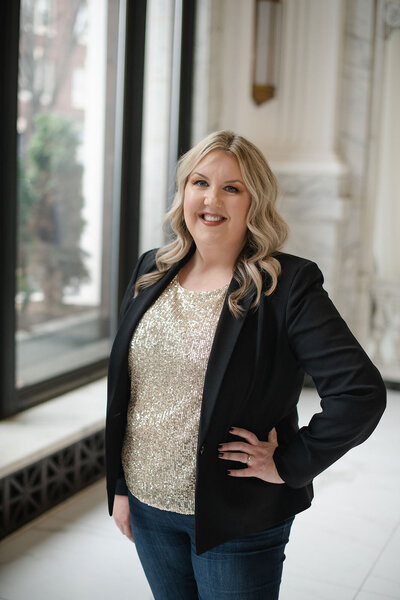
In this episode, I sit down with Christine Hummel, a healthcare executive with 25 years across the pharmacy benefit manager side, retail and specialty pharmacy, distribution, and pharma manufacturing, including running US Trade and Channel for a major pharma company. She and I get into what she’s actually seen from inside hiring and promotion decisions, and why the women who get chosen for the next role are the ones that stand out in very specific ways.
Her answer isn’t about your credentials, and it isn’t about waiting for someone to notice how hard you’re working. It’s about the network you build and the characteristics you demonstrate long before the opening exists. This is a jam-packed episode where we discuss the realities of working in industry as a woman who is high achieving and looking to build and sustain her worthy career.
What You’ll Learn
- Why chasing the next title can actually slow you down
- What Christine actually looks for before she puts someone’s name up for a promotion
- The one question to ask yourself before you consider leaving your company for a title
- How to build a network that gets you noticed without waiting to be chosen
- Why AI belongs in your career strategy starting now, not later
Key Takeaways
Stop chasing the ladder, start diversifying your experience. Christine built her career around motivators like innovation and team-building, not company size or title. The women who advance fastest treat every move as a chance to learn something new, not a rung to climb.
The people who get promoted aren’t the most technical, they’re the most characteristic-driven. When Christine rebuilt her team, she hired for enterprise-wide thinking, growth mindset, and curiosity over resume-matched experience. She can teach the tactics. She can’t teach the mindset.
Do the internal work before you leave for a title. Set up quarterly one-on-ones with three to four people outside your department, get curious about the business beyond your job description, and build that same kind of network externally.
Advocacy is earned, then asked for. Leaders advocate for people who deliver on current KPIs, show a growth mindset, and actually want the next move. Even then, nobody is thinking about your career for you. Write the job description you want and ask for it directly.
Take more risks, and treat AI as strategy, not a threat. Christine’s top piece of advice in hindsight, and the one she hears most from the women she talks to, is simple: take more risks. She’s also pushing women executives to get ahead of AI now, including building an AI work group inside their own team.
The strategic lens here isn’t personality, it’s a body of small, deliberate moves: the network you build before you need it, the questions you’re willing to ask, and the ask you finally make instead of waiting for someone else to make it for you. Tune in to hear how Christine built visibility across four sides of the healthcare industry, and what she’d tell her younger self to do differently.
Connect with Christine:
- Connect with Christine on LinkedIn here.
- Listen to the Root to Rising podcast here.
- Tune in to my interview on the Root to Rising podcast in the episode, How to Build a Career You Don’t Need to Escape From, here.
Ready to Take the Next Step?
If you want personalized support applying this work to your own career, learn more about The Right Move Protocol—my coaching experience for women in Pharma and Biotech who want strategic career growth.
RATE, REVIEW, AND SUBSCRIBE TO APPLE PODCASTS
If you are loving the podcast, please consider rating and reviewing my podcast! This helps me support more people — just like you — to get happier in their career and their life by making the show more visible.
Click here, scroll to the bottom, tap to rate with stars, and then select “Write a Review.” Let me know what you loved most about the episode!
Also, if you aren’t already, be sure to subscribe to the podcast. If you’re not subscribed you can miss out on any bonus episodes! Subscribe now!
Transcript
Melissa: [00:00:00] All right. Okay, welcome to the podcast. So today I have a very special guest. I have an inspiring executive that has worked across industry and healthcare, and we are gonna be talking about her advice, her career journey, and her name is Christine Hummel. So welcome, Christine. Thank you so much, Melissa, for having me on your podcast, as I know you were on my podcast, Rich Rising, previously.
Christine: So the favor is coming back. Um, but I am Christine Hummel. Uh, I’m a healthcare executive. I’ve been in healthcare, corporate healthcare, for over 25 years in all parts of the spectrum. I’ve been on the pharmacy benefit manager side. I’ve been on the retail specialty pharmacy and strategy side, also distribution, and also the, the pharma manufacturer side.
Melissa: So a holistic view of, uh, the healthcare system, and it’s, it’s pretty much the same story. It’s just a different perspective of how you look at that story. Mm, that’s so [00:01:00] interesting. So when I looked at your history, and when we, we talked about it a little bit, um, also when we first got introduced to each other, I found it really interesting how you worked within industry in big pharma, and then you also worked within healthcare.
And I’m curious, from your perspective, how do you see those as similar, or what went into your decision-making that you’re kind of going in between both? Yeah, great question. So I look at it as, first of all, when you’re in healthcare, you’re in it for the patient. In some way, shape, or form, we’re touching the patient every day, no matter how removed you are.
Christine: At the end of what I do, I feel like I’m providing some kind of greater patient access, um, for that patient in need of that therapy. So if you look at the healthcare continuum, I always look at it in the view of the patient journey, and the patient has to have a diagnosis, they have to have the appropriate prescription, all the way to, you know, receiving the product and staying adherent.
[00:02:00] So all the different entities along the way that I worked for, in some way, shape, or form impacts that patient journey, and then its perspective of how they can contribute to patient access along that journey. So the different companies that I’ve been in, for me, it’s been the same patient journey continuum, but I am motivated by innovation, transformation, being challenged, and I love to build, build things.
So for me, the, the different transitions to the companies weren’t so much about small, medium, or big company, or even what they were doing. For me, it was something different where I could innovate, I could learn. Every job I went into, I didn’t necessarily know all the answers, but I felt like I had the right characteristics, the right skills- Mm
that were transferable from the one job to the other to figure it out and build great teams. So for me, the company size is something I really didn’t take into consideration. I know many [00:03:00] do, um, because of processes that are established or they feel like they can move faster in one or the other. But my own individual goal is every meeting, every objective, everything you do should have a business impact, and you should always be wanting to move at that same pace.
Melissa: Um, so for me, it was more about following my motivators that were innovation, transformation, and building great teams. Mm. That’s great that your values are really guiding your decision-making, and so to you, it’s not so much the specific industry or company as much as that role and that company aligning with your values.
Christine: That’s right. So, so to give a little bit of context, um, can you describe what your role was in industry when you worked at Sanofi versus what your role is now? Sure, of course. So, um, when I recently was at Sanofi, I was responsible for the US Trade and Channel team. And what that means, if you think about a drug manufacturer, for any drug, for small molecule all the way to [00:04:00] biologics, how anyone from the US wants to purchase that product in order to get it to the patient.
So if it could be a retail or specialty pharmacy, it could be a hospital, could be a GPO, could be a wholesaler, distributor, any entity today that is intermediary to get drug to the patient. Could be direct to provider even in some scenarios. So it was a responsibility for the team to lead, um, those customers that were external facing, negotiate drug pricing contracts with them, or fee contracts with them appropriate for the service across all of US Sanofi port- drug portfolio, and then making sure from a contractual perspective, we were pulling through those obligations and, and again, getting the drug to the patient.
And our team’s overall objective and mission was to provide the greatest patient access for minimizing the gross to net. So as many drug manufacturers today are aware, gross [00:05:00] to net is how you measure, um, profitability or impact to the cost of the product. So there are so many fees and discounts that each manufacturer has to put into a different drug to get that drug to the patient.
Um, so we were very, um, responsible in terms of the trade and channel team of developing the gross to net model, and then the broader market access team that was led by head of market access. There was a very strong framework that governed the entire market access team that looked at everything from a gross to net lens.
So you have a holistic view of every fee, every discount, every rebate across the entire… If you, if you think of that vertical integration slide that we all know, that keeps growing with you at the top line of the insurers and then all the entities within That represents 95% of US healthcare. So our response to the market access, um, team was [00:06:00] look at everything in response to that, and look at it from a gross to nets perspective.
That also includes 340B impact, MFN impact, IRA impact, co-pay card impact, all the good things that the drug manufacturers need to include in that gross to net model. So it was a balance of, you know, working with our customers, our partners across all the different pharmacy wholesaler channels. It was negotiating, you know, fair pricing and contract rates, along with being responsible, um, you know, from a gross to net perspective, and making sure we were doing the right thing to continue to invest, you know, dollars financially into innovation.
We have to continue to grow the drug pipeline. It doesn’t just happen. Um, you know, there’s different therapies out there for a reason, because drug manufacturers invest billions of dollars every year for drugs that sometimes make it to the market. I think the recent number, and Melissa, I don’t know, quote me on this, but I wanna [00:07:00] say it’s, like, 10 to 12% of drugs that actually go into research in phase one actually are approved, um, and actually are FDA approved.
So there’s a lot of the, the 90% plus that are investments by drug manufacturers that we never see the value of that because, you know, the drug didn’t make it all the way through the different phases. So, um, you know, there’s a holistic view and responsibility the trade and channel team had, and again, we were, um, within the market access team, which allowed us to have a holistic view of the US healthcare market.
Melissa: So interesting. I mean, it, it’s very evident that your experience really spans over a lot of different layers within the industry that I think even just the way you just described that is even gonna be educational for some of the listeners of this podcast. So thank you for sharing that context. Um, when I thought about the conversation to have with you, and knowing just your deep expertise, [00:08:00] being a woman executive, um, within healthcare, within industry, I know a lot of the people that listen to this podcast are looking to grow personally and professionally.
Christine: They’re looking for leader recognition, or new roles, or to get promoted, and sometimes they feel stuck or overlooked or kind of lost in their career. And so I think between the both of us, we’ve worked with and been exposed to a lot of really technically excellent women that still feel kind of overlooked, despite how credentialed and hardworking they are.
And so I’m curious from your experience, what do you think is a reason that someone that you would describe like that would get passed over for that next opportunity? So I’m gonna flip it a little bit and communicate how I look at things, and then, you know, go back to answer that question. So I do believe that a lot of women executives [00:09:00] follow and have planned a linear upward ladder path for themselves.
They create this journey of, okay, I’m a director, then I’m gonna be senior director, vice president, and so on. Um, if you don’t look at it linearly and you try to expose yourself to more of learning diversity in roles and taking even a lateral role sometimes but to learn something different, it allows you two things.
One, to have exposure to different types of work, different, um, skill sets, different people. And number two, it allows you to become more diversified in your resume and your experience is therefore more valuable. But I would say that Women, in my opinion, should flip it a little bit and take a more individual look, that they’re not defined by the ladder.
They shouldn’t be defined by the title, and I, I do believe they’re looking for the [00:10:00] next, and the next is defined for them by the title. If you flip it and you have more of a mindset, and it, and it takes time and patience and a lot of self-awareness to do that, but understand what motivates you, understand what challenges you, understand when you feel that you’re at your best.
Like, there’s moments that you’re doing a project or you’re having a negotiation and you feel it. Like, you’re like, “Wow, I love this right now. Like, I feel really good about myself.” Remember that moment in time where you had that feeling and connect all the dots on the why you had that feeling. What, in that moment, did you enjoy?
And I would argue, if you stay true to what motivates you and you diversify your experiences and you put yourself out there, no matter how uncomfortable you are about taking a ladder, lateral job you don’t know about, you will have more opportunities presented to you. And instead of striving for getting to the next ladder, because I [00:11:00] think when you’re looking at just the ladder, it becomes very linear and tactical and you think of certain checklist things you have to do, and let’s, let’s be honest, women are checklist people because we have, you know, 100 things all the time in our brain checking off.
But think about it differently. Don’t think about it as a checklist. Think about, as a broad universe, and you’re just trying to pull in every opportunity to learn, to diversify yourself, to become, you know, a better candidate for that next role. And by the way, you probably will be a little bit happier doing things that way because you’re having different experiences and you’re figuring out who you are along the way versus letting a ladder define you.
Melissa: So I know I kinda answered the question differently, Melissa, in terms of what tactics or skills, but I think we have to shift our mindset and look at things differently on a much broader scale versus having this tactical approach. Yes, I completely agree. I actually call that finding your hidden door. [00:12:00] So instead of going up the ladder, it’s let’s figure out what is really best for you, and then create a strategy for you to find that hidden door that’s not gonna be available on a ladder because it’s uniquely positioned for you.
So, um, that’s refreshing to hear. How would… I guess when I’m thinking about that, if someone is, is at work and they’re thinking, “Okay, I need to kind of figure out what really lights me up and be open to things outside of the title,” sometimes We might just feel really entitled for that title, and I see a lot of advice or just this idea that you should just leave your company in order to get that title somewhere else, that it’ll be easier to get it if you just leave the company.
Is there anything you can share on, I guess, what women should consider before leaving their company and instead maybe a way that they could reshape their role where they’re at or, um, maybe go through the hard work of [00:13:00] building the skills to be successful in a space and solving the problem of why am I not advancing as opposed to I’m gonna give up here and go somewhere else?
Christine: Yep. So, you know, the first question I would say is, you know, why are you striving for the title? In my opinion, you should never strive for the title. You should always strive to individ- individually make yourself better and improve yourself in any way, shape, or form that you want to. Um, that, that title doesn’t necessarily make you better.
That title is just a label that we feel like we need to prove ourselves, because we’re continually wanting to prove ourselves. So some things, you know, women can do is, number one, is don’t make it just about your job. Your job is a title, it has a job description. Evolve it. Make it bigger. Be curious about your job.
So for example, I tell people all the time, you should have three to four people internally at your company outside of your department that you are network- thing on a [00:14:00] regular basis. If it’s once a quarter, once a month, depending on your bandwidth, set up one-on-ones, be curious, ask them questions about what they do, what they like about the company, what they like about their role.
Where do they see healthcare going? What trends do you see impacting, you know, our organization? What trends impact our jobs? How will AI impact what we’re doing? Be curious and ask people questions, and have a conversation outside of your title and your department. And then the second thing I would say is it’s not all about one company.
It’s about the broad universe of what you wanna do, if that’s healthcare or something broader. So be curious and develop a network outside of your company. Have three to four women that even outside of your industry, maybe it’s even outside of healthcare, but maybe it’s a job description. You know, we all stalk people on LinkedIn, and sometimes I’m like, “Wow, this person has a pretty cool job.
I wanna learn about it.” I will message them, and I will ask them for a conversation, and I want to learn what [00:15:00] they’re doing, why they’re doing it, and be curious. So I would think building a network internally and externally and not making it about the title and the job, you will naturally build this network of men and women and just people in your industry that now you’re curious.
Now you’re having different conversations outside of just the title and job description, which makes you much more marketable and much more diverse. And the curiosity, you know, people don’t hire for the skill set, in my opinion. I just restructured a team a year ago, and I didn’t hire for experience or knowledge Of that certain, like let’s say, specialty pharmacy.
I looked for characteristics. I looked for enterprise-wide thinking. I looked for problem-solving. I looked for, um, having a proactive mindset, growth mindset. Um, I looked for having, you know, a, a gross to net, a holistic view of healthcare. So if I, you look for the characteristics, and you as an [00:16:00] individual communicate those characteristics, you become curious about your own characteristics, that makes you very much marketable that I hired people that didn’t even have experience and skills in certain areas.
I’m like, I can teach them specialty pharmacy, but they have great growth mindset. They have a great strategic account management, um, mindset. I want that person. I can teach the rest. So I wouldn’t make it more about the title. Again, I’d go back to what I said previously. Go broader and diversify your skillset, and you’re gonna probably be more satisfied anyway because you’re not, it’s not a linear next step approach.
Melissa: You’re having your small wins by having, you know, l- small conversations with your network, and you’re growing from that versus having the title, you know, giving you this faux fulfillment that you’re looking for. Mm-hmm. That’s good. I was gonna ask you if, um, there were things that you think that women don’t know about advancing, and it sounds like [00:17:00] it’s really the relationship building and those characteristics, like those strategic skills, um, that might be missing.
And I think, uh, that’s what I see a lot with my clients too, is there’s a gap where they’re focusing harder and harder on their technical skills and padding their resume and being the best expert in the room as opposed to being the best leader of their domain, of the area that they work, and knowing they don’t need to know everything.
Christine: It’s more the characteristics that are gonna make them successful. Agree 100%. I mean, there’s people that we can hire. There’s a lot of competition just for the tactical and technical skills. Even the kids that are graduating college right now, the ones I mentor, everyone’s gonna have a degree in the same, in the same category within your school, school of business or school of communication.
How are you gonna differentiate yourself? It’s that same mindset that I would say to women here. It’s not about the technical skills. Pull it back. You, anyone can do… I don’t say anyone, but at this [00:18:00] point of our, of our professional careers, anyone can have that experience. Um, so I would say how do you diversify and differentiate and broaden yourselves at this point?
And that’s through those different conversations. And pull it back, like pull it back up, and don’t make it about your job, make it about healthcare industry trends. Have some forethought to say what’s coming in the next three years. When you go to that interview, talk about how healthcare is going to evolve, how it’s gonna change, what’s gonna change, because a leader doesn’t hire just for those tactical skillsets.
They hire for someone… When I hire someone, I hire for them for the next four jobs. I already know that they can be put in four different roles, either within my team or within the company, and they’re gonna be growing. And so when I hire, I’m not looking for just the technical, I’m not looking for just the experience, I’m looking for the characteristics.
Melissa: Mm-hmm. Yeah, it makes me think of the conversation we had on your podcast about [00:19:00] AI, ’cause I think this is also how you can kind of protect your career when you have so many people with the same resume, is through- Yeah … these skills that you’re discussing. So I’ll link to your podcast and that episode specifically too, so, um, people can check that out.
Christine: Because I know that that’s also a fear that women have, is that they’re going to be kind of pushed out of something they’ve worked so hard for because of AI, and I think they’re really, um, not putting enough weight into how these skills can really change the trajectory of their future. Um- Yeah. I’ll, I’ll give a, a quick snippet on that, is don’t be afraid of it.
It’s here to stay. Figure out how to embrace it, and think of it as it will enhance you. And one thing women executives can do to differentiate yourself, teach yourself or take a class on AI. As painful as it is, do it, because in the next one to two years, it’s going to be here and you’re gonna already be behind.
Melissa: So I would say that’s one thing right now. And I did it. It’s not easy, but I am now fascinated by [00:20:00] it and it makes me more efficient in my day. So embrace it ’cause it’s here to stay Yeah, another, um, great idea I just thought of as you said that is I have a client who is an executive director, and she said that she integrated the AI conversation into her team meetings.
She just scheduled a 30-minute conversation just to say, “What are you learning in AI?” And just kind of knowledge sharing around- Yeah … what are you learning? What do you think is cool? What do you think isn’t working? And- Yep … um, a lot of excitement came from that, just to see how approachable it could be, but also to see what your peers and your teammates might know, and to see where it could be used and maybe where not to use it.
Christine: But it’s making it part of the conversation instead of being afraid to have the conversation. Agreed. And as a woman executive, here’s something you can do with your team. I’d create a, an AI work group. Pick four or five people, and then have them figure out over the year how they’re gonna teach the rest of your team, and have them lead it.
Melissa: Give responsibility, delegate to the people that have more c- you know, more abilities right now, and [00:21:00] that’s a way you can grow your team. Don’t be afraid to use your team for, to help you get smarter too. Mm-hmm. Such a good point. Um, so when you advocate for someone, if you imagine leadership meetings you’ve been in or maybe succession planning meetings, talent reviews, when you’re advocating for someone that you think should go into, whether it’s a nine-box grid or whatever for that, that future talent role, or you’re talking about, you know, multiple roles in the future, or maybe you’re putting their name up for a promotion and they’re not in that conversation, what are they doing to earn that advocacy from you?
Christine: They are really following those characteristics that I talk about. I see them not just for the job they’re currently doing. They’ve kind of outgrown the nest, right? They’ve, they’ve expanded and exploded within the role. They are now ready for the next in terms of they have already taken on curiosity about…
For example, if I have someone in specialty [00:22:00] pharmacy, l- a senior director, uh, she’s curious in leading a GPO team, um, I’m ready to allow her to go to the GPO team, not because she knows about GPO, because she has the characteristics and the ability to make it successful, and she will learn the GPO, right?
So she’ll learn the tactics. So if I see those skill sets being exemplified, that growth mindset, curiosity, enterprise-wide thinking, and there’s always results. They have to be successful in their current role. So they have to be driving ROI and whatever their KPIs are within their role. And for me, I’m a big financial and data person, so you better be bui- you know, delivering gross to net impact, um, for you, for me to even, you know, consider you for that next role.
So it’s a, it’s a combination of being successful in their objective and their KPIs in their current role, but having that mindset. And, and also they have to be wanting to do something different. [00:23:00] Not everyone wants to go on to the next role. People sometimes are very satisfied, you know, continuing to evolve in that role.
So if I wanna bring someone to a different team, I am having one-on-one conversations with all of my teams every quarter to understand where are they at with their professional development. If they’re good this year and they don’t wanna move, then I won’t, I won’t suggest them for that. So it’s a two-way conversation you have to have with each of the people on your team or your leader.
And one advice I would give to women executives is don’t assume everyone’s gonna advocate for you. Everyone is moving 100 miles a minute. M- male or female leaders are super busy. You have to advocate for yourself. So if you want something, write the job description. Tell them the why. Say to them, “I’ve done X, Y, and Z in my role.
I’ve delivered value. I have these characteristics. Here’s the job I want.” Or write it. “Here’s what my job is today. It’s evolved. I [00:24:00] really think I can do this type of job.” And ask for it. And what’s the worst thing that can happen? They can say no, or they can say maybe later. But if you don’t ask, people aren’t gonna give it to you.
People don’t sit around thinking about each of us for, you know, eight hours a day and what your professional development career is. They have 100 different people. They have 100 different initiatives. They’re getting pressured by, you know, their leadership. So make it easy for them. Have the conversation, and don’t sit there and say, “What should I do next?”
Melissa: Come to them with a plan. Come to them with a job description. Tell them what you want You’re absolutely right. Um, so other than maybe not developing those strategic skills, not advocating for themselves, is there anything else that you’ve seen as maybe a pattern that women specifically might do that kinda sabotage their best efforts for growth?
Christine: What I normally see is they’re waiting for someone to recognize them. They’re [00:25:00] waiting for someone to acknowledge and ask them to do the next, versus them taking the initiative to make the ask. That’s probably the biggest thing, and when I see that, um, again, if you’re having continual r- conversations with your leader, it shouldn’t happen.
But if you’re sitting around waiting for someone to come tap you on the shoulder, you’re gonna be sitting there for a long time. You have to be the one to initiate the conversation. So I would say, you know, and don’t wait until you’re ready. You should always know when you’re in a role what… You should constantly have check-ins with yourself.
Melissa: Is this motivating to me? Am I enjoying this? If I were to do something different, what would it be? It’s not like you end a job and you’re ready for the next. It should be a continual evolution as you’re continuing to think about your next steps. Mm-hmm. I think that sometimes women, too, can keep their head down, um, as far as they might, they might advocate for themselves and hear a no, and then just [00:26:00] kind of go back and keep their head down and just do the work and hope the recognition comes.
Or they might, um They might think that if there’s some sort of constraint within the organization or maybe a direction the organization’s going, like I, I know right now with AI, with a little bit of market volatility, there’s a lot of changes going on, and that technical competence isn’t enough. And so some leaders will resist that they need to lead differently, and that can hold them back because they’re not looking at, okay, the organization is changing, how can I lead in this new kind of era versus I’m gonna just be miserable that it’s not going the way that I want it to and then maybe leave and find somewhere else that is more aligned.
And I just, I think it’s so important that you build the skills to grow with your company, ’cause your, your company, no matter where you work, it’s, unless it’s your company, you don’t get to set the direction. You’re there to support the [00:27:00] objectives, and hopefully you have a place that you can influence those objectives, but you’re there to problem solve and to figure out how to bring that mission and vision to life.
Right. And I think sometimes women get really stuck in, “This isn’t the way that I think it should be.” Yeah, and I think a lot of women, we do a really good job of being super polite and we don’t ever wanna hurt anyone’s feelings and we’re, you know, we’re people pleasers, and we’re afraid if we get rejected.
Christine: It doesn’t feel good. Um, we wanna fit in. We’re, we’re continually trying to be perfect and prove ourselves, and it’s exhausting, right? Mm-hmm. So again, it’s important to, it’s not about the acknowledgement or the ladder, and it’s not… Think about it. It’s only one person. Your manager at that time or your leader at that time is one person in your life that has all the responsibility to give you that next role.
That’s a lot, a lot of responsibility for that person. Don’t make it that person’s responsibility. Make it your own. And so if you think about just having all of your future in that one [00:28:00] person’s hands- You wouldn’t do that with any of your family. You wouldn’t put it in one person’s hands. So that’s why the diversity to expand your network and to have different conversations with other people than just your leader is so important, and to make sure that you’re not just looking at your job.
You’re not putting your head down, and if you say no, get up and try again. Figure it out. Like, there’s plenty of no’s that are gonna happen, and that’s okay. And the companies will continue to shift, right? I had someone when I, um, was transitioning from Santa Fe to my current role at Leap, someone said to me, “We’ve had four leaders in the past six years.”
And I said, “Correct, and you should have adaptability and resilience to respond to that because that’s not gonna change any time soon.” This industry is moving fast. There’s a lot of changes happening. I know regulatory, um, government, all over the place, and this is the way it is. People are moving faster.
Melissa: We’re becoming smarter as humans. So [00:29:00] be adaptable and respond to that. So you’re not gonna have the same leader for 24 years anymore. That, those days are gone, and so you have to have the adaptability and the resilience, and even more so, that’s why you have to diversify the people that you know and create your network to get you through the evolution of healthcare Yes, and you talked about growth mindset, and I think a lot of us think that we have it when we don’t, or think it’s kind of black and white, and I think that there are parts of your life or your career that you might be able to practice that growth mindset a little bit more than others.
Um, and so there’s an opportunity to look at where are you maybe being too protective of your reputation. A lot of the women that I talk to, like deep down, they worry, for example, if they’re working on something and they’re given the, the task to create a strategy, that they, they don’t wanna ask questions ’cause they don’t want to seem like they don’t know the answer, when really that’s then creating them looking like less of an expert because they’re not bringing in the [00:30:00] experts that could contribute or they’re not getting the right information so that then when they go and present that strategy, it doesn’t have all of the right information that it should because they didn’t wanna ask questions.
Christine: Um, or just being worried that if they fail or if they go after something and don’t get it, that it’s just gonna somehow be this like career ending reputation failure. Yeah. Right? And it’s like the more that you go after those things, the more you build that resilience, like you’re saying. Yep. Yeah. Yeah, and, and when someone, when your leader says to you, “Build a strategy on X, Y, and Z,” they don’t expect you to have that answer in your brain.
That’s not the ask. The ask is figure it out. It’s utilize the people on your team or externally or AI or however you wanna get your 5,000 pieces of information. They give you that responsibility ’cause you can figure that out. If they expected you to have that answer, um, you know, no one has that kind of answer.
Uh, also would be no job for it. So [00:31:00] it’s not about delivering so much on the question they’ve asked, it’s about how you build it and how you get the strategy using the different people or assets around you. And again, it goes back to what we talked about. Women, I think, do have to do a better job as leaders to delegate and trust their teams and build their teams and invest with them, because it will make you a better leader in return.
Melissa: It’ll allow you more time and allow you to grow if you utilize your teams, um, and you have to trust them to do that. Mm-hmm. Is there anything, if someone were to say, “Okay, I want… I… This is really useful information, you know, I wanna take two or three things and implement right away from this conversation,” what would you suggest?
If they were looking for their next job opportunity, or just to become- Mm-hmm … more strategic versus tactical? What’s the, which one? It would be, I would say just, um, growth and recognition, whatever that might look like, whether it’s a promotion or being seen as a standout leader. [00:32:00] I would do probably three things.
Christine: One, I would build your network. I would immediately set up calls internally with people that you know are interesting to you, have political influence, they intrigue you about what they do, you don’t know about they, what they do. They could be without your, you know, outside your department. Set up those one-on-ones, talk to them about what you’re doing, ask them questions about the healthcare industry.
And know about it too, by the way. Do some research. Ask them industry trends that they think are gonna impact our business. Ask them… And you’re selling yourself, right? But you’re asking them questions to sell yourself. Um, so build your network internally and then externally, as we talked about, because there’s a lot of pretty cool companies out there, and your company may not be the end-all be-all.
Diversify and see what else is out there and give yourself a market check. And continually see and pressure test what else is out there. The second thing I would do is don’t treat every [00:33:00] accomplishment as a title. Think about it as when you learn something new or your, your wins are when you feel motivated.
So my win is when my team was built and they were all in place and I saw that synergistic effect of them coming together. I took that as a win. I didn’t need the title. Um, I needed that sense of accomplishment from a building a team. So find your motivators and, uh, just celebrate the small wins and don’t make it about that linear approach to the title.
And then the third is be curious and do not be fearful. Ask the questions. What do you have to lose? The only person that controls your confidence is yourself, so give yourself the confidence. You’ve earned it. Ask the question. If they say no, continue your journey. It’s an evolution, it’s not a dead end. So don’t look at that, um, you know, person, your leader, as the end-all be-all.
It’s [00:34:00] one person out of many different people throughout your life journey. So that would be the three pieces of advice. That’s so helpful, and that, um, that piece you said around the only person that controls your confidence is yourself, it, like, gave me chills when you said it. Good. Like, I think, I think that’s something that people need a lot of, um, they need to be reminded of because they think- Yeah
Melissa: that whether or not they have it, it’s just happening to them- Yeah … and it’s not in- Yeah … their control, and I think that really helps show how much it is in their control, so that’s awesome. Um- Yeah … so I wanna talk about your podcast, um, for a minute. Yeah. So you launched a podcast, Route to Rising, as a sitting executive, and I’m curious, I’m sure the listeners are curious too, what made you decide to build that public voice while you were inside of a company?
Christine: So it started from, I used to mentor and coach many, uh, younger females because my daughter’s now 23 years old. She’s a graduate of college and in the working industries. And when she was in high school, I was mentoring and coaching so many women, and also in my roles as a, as a [00:35:00] executive leader, I had so many people coming to me on the side saying, you know, “Help me.
What do I major in? What should be my next job? How do I get confidence?” Um, and the questions, I was just on repeat, and I’m like, “There’s gotta be a bigger way and a broader way to impact more people,” ’cause I’m saying the same thing over and over, right? So, um, it was the idea. I had met someone that started a podcast.
He was very familiar with the setup, ’cause it was very overwhelming. The, the whole technology and editing part is probably the most overwhelming, believe it or not. Um, so helped me learn the skills how to do that, and then just started about a year ago and having those conversations between the younger generation, what their questions are, what their experiences are, and then now more the experienced professional, like what you’re doing with your, you know, people that you’re helping is, how do we help the people that are our colleagues, that are, you know, similar situations or similar professional, um, experience as us?
Melissa: So it’s just [00:36:00] evolved over time, um, and it’s been great, and I’m hoping that, you know, some of the younger generation of women, like with the conversations you and I have, help them be stronger and when they get to this point in their career, they definitely have more answers than we do. Yeah, for sure. I think it, the conversations on your podcast are really great, especially for that younger population.
Like, they’re… It’s, I think it has such a great potential to… It already is shaping how these women specifically look at their careers, the decisions they make, don’t feel like they have to have it all figured out, and are bolder and braver than we might- Yes … have been at their age. So that’s amazing. Yeah.
Um, like I said, we’ll link to that so our listeners can check that out. Um, so I have a standard closing question that I like to ask, um, guests that come on the show. What is a piece of advice that you wish that you had earlier in your career? Take more risks. Mm. Um, and I… One question I ask similarly on my podcast is, “If you would do something different [00:37:00] knowing what you know now, what would that be?”
Christine: And 75% of the time the women say, “Take more risks.” And I think it goes back to, Melissa, of your question of, um, don’t strive for the perfect, right? Don’t be safe. Take the risks. What’s the worst thing that can happen? You have one career journey. Why not ask the question? And I wish I would’ve probably taken more risks, and be okay with being uncomfortable ’cause you just grow when you’re uncomfortable.
Melissa: That’s such a good reminder. Um, so that was all of the questions that I had for you today. I feel like we could talk all day once again. Agreed. Um, is there anything that, um, you want to mention that we didn’t talk about? No. I would just say, you know, healthcare, where you s- you know, are very specific in the people you help, it is ever-changing, and it will continue to be hard.
But it allows us to deliver, you know, at the end of the day, a patient their medication. So get through the hard and [00:38:00] always have that greater mission and the greater good as kinda your governing rule of thumb, and everything else will follow. Okay. That’s, uh, such great advice. Thank you so much. Thank you so much for being on the podcast.
Christine: You’re welcome. Sharing all of your wisdom. Thanks, Melissa, for having me. You as well. Thank you. Thank you so much. Bye.